Phần này bàn về chương 38 trong cuốn Nam Hải Kí Quy Nội Pháp Truyện của pháp sư Nghĩa Tịnh. Chương/điều khoản 38 Thiêu thân bất hợp 燒身不合 tạm dịch/NCT: thiêu xác thân là không hợp lẽ trong PG.
Các chữ viết tắt trong bài là NCT (Nguyễn Cung Thông), PG (Phật giáo), HV (Hán Việt), VN (Việt Nam), A (tiếng Anh), P (tiếng Pháp), NHKQNPT (Nam Hải Kí Quy Nội Pháp Truyện).
Phần này bàn về các tục lệ tang chế truyền thống ở Việt Nam từ thời LM de Rhodes và các giáo sĩ Tây phương sang Á Đông truyền đạo. Đây là lần đầu tiên cách dùng này hiện diện trong tiếng Việt qua dạng con chữ La Tinh/Bồ (chữ quốc ngữ), điều này cho ta dữ kiện để xem lại một số cách đọc chính xác hơn cùng với chữ Nôm, cũng như một số tục lệ không còn hiện diện nữa.
“As Togo’s foreign minister Robert Dussey told the assembly, “A fair map does not change the geography of the world, it changes how we see it.”
Why the UN Wants a Different World Map
Key Takeaways
On Sept. 4, 2026, the UN General Assembly adopted the “Correct the Map” resolution by a 164-1 vote, endorsing the Equal Earth projection.
The non-binding resolution encourages governments, schools, media, international organizations, and technology platforms to use equal-area maps when comparing the sizes of continents.
Unlike Mercator, Equal Earth preserves the true relative size of landmasses, dramatically changing how places such as Greenland, Canada, and Africa appear beside one another.
For more than four centuries, the Mercator projection has shaped one of the world’s most familiar views of the planet.
The icon map was designed to make navigation on the Earth’s oceans easier, but it came with a cost: the farther a place lies from the equator, the more dramatically its size is exaggerated.
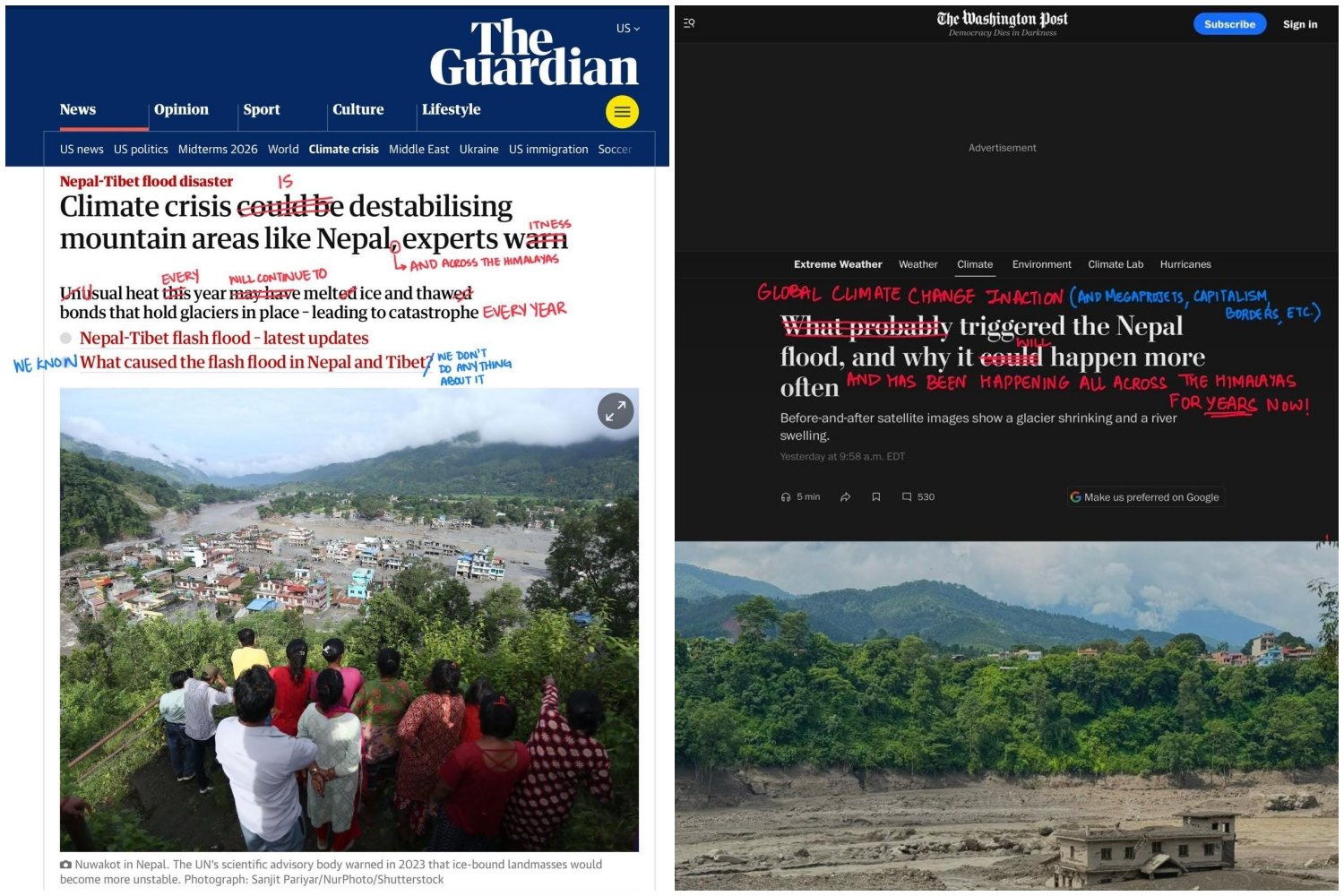
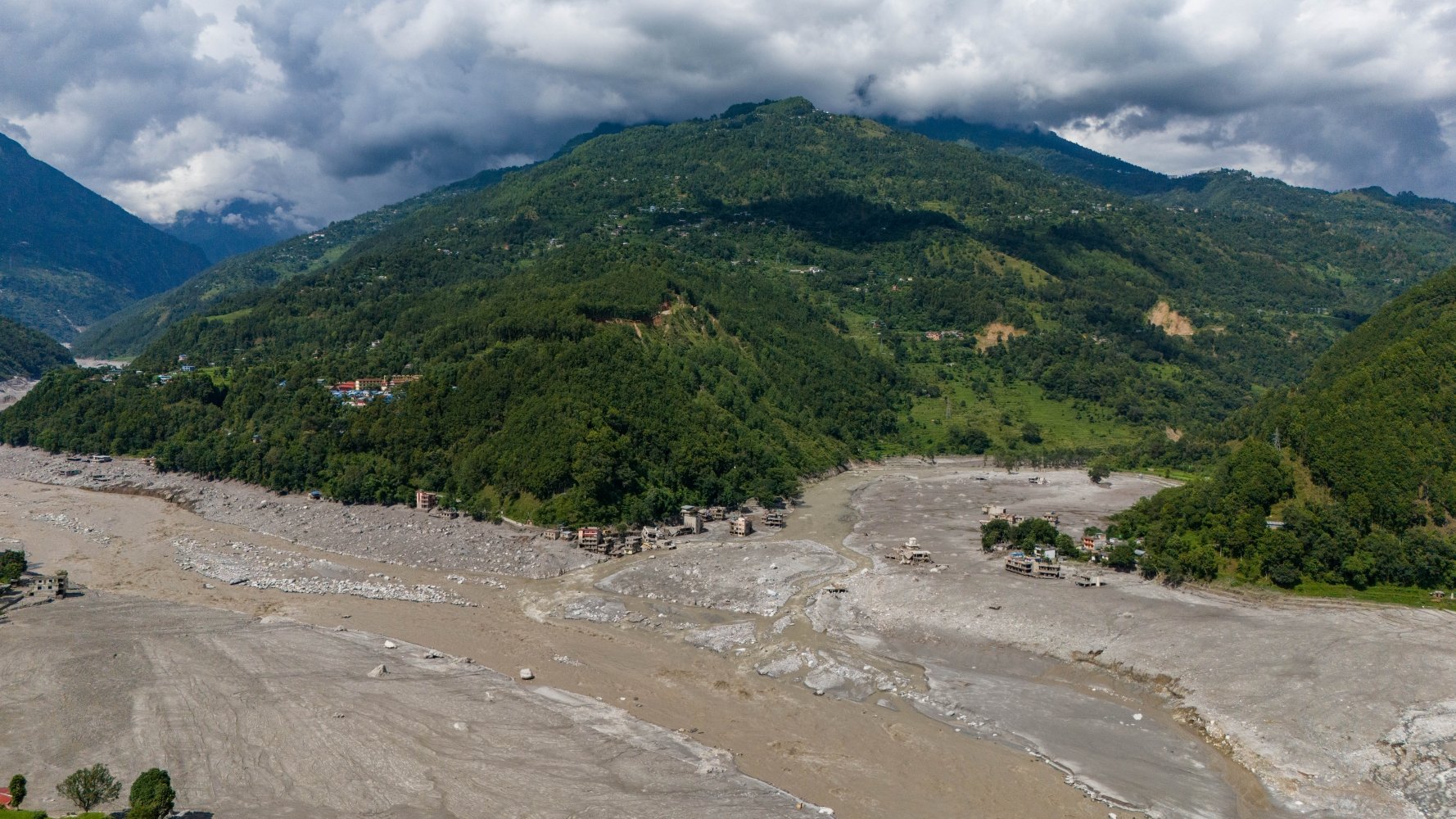
In coverage of the catastrophic Bhote Kosi flood, many mainstream western news outlets have failed to confidently state the significance of the climate crisis, or to cite the human-made structures that produce it.
Headlines from The Guardian (left) and The Washington Post (right) covering the Nepal-Tibet flood, marked in red by designers and former Harvard classmates Fatima Hamdani and Bhavya Jain. Photos: FATIMA HAMDANI AND BHAVYA JAIN / INSTAGRAM In coverage of the catastrophic Bhote Kosi flood, many mainstream western news outlets have failed to confidently state the significance of the climate crisis, or to cite the human-made structures that produce it.
Two days after catastrophic flooding began, designers and former Harvard classmates Bhavya Jain and Fatima Hamdani posted a carousel of headlines plucked from mainstream western news outlets on their Instagram.
By taking a red pen to each headline in the style of Alexandra Bell’s Counternarratives series, Hamdani and Jain called attention to journalists’ noncommittal tone, which served to obfuscate the connection between the Bhote Kosi flood and climate change.
The post went viral, with more than 32,000 likes at press time. In an accompanying article on Hamdani and Jain’s shared Substack, Climate Without Borders, they write that news agencies “quote survivors’ shock and panic” but not “experts’ warning from decades past on the climate crisis.”
“Ambiguity is always dangerous because it shies away from responsibility,” Jain tells me. “It is the work of the media to bring attention to evidence that has been ignored or years now.”
DENIALISM
While Hamdani and Jain call out mainstream western media for failing to establish a strong causal link between the flood, glacial collapse, and the warming atmosphere, some argue that western journalists are using climate change as “an explanation without evidence.”
One phone call saved thousands of lives after river gauges were swept away on 26 August
Devesh Belbase·Aug 31, 2026·NEWS
Photo: SUMAN NEPALI
Going by the numbers Nepal uses to define danger, the flood of 26 August was unremarkable.
At 8:40am on 26 August, the automatic gauge on the Bhote Kosi on Nepal’s border with China recorded the water level at 1.62m. It was low, and falling.
That was the last reading of the Rasuwagadi station. The wall of water coming down the Lhende Khola destroyed the equipment before the next reading was due. The gauge at Syaphrubesi 15km downstream died when the water level reached 3.8m. Betrawati was knocked out at 3.55m. These were all below the prescribed Amber warning thresholds.
It was 4pm by the time the flood peaked at 6.57m in Devghat, 170km downstream on the Narayani River. That was the highest point measured during this flood event, but still below the Amber warning level of 7.3m (see charts).
Devghat is the last gauge on the river, and it stayed green throughout the flood of 26 August.
But upstream, hundreds of people had already been swept away the fury of the mudflow. Between Rasuwa to Chitwan, 22 concrete bridges were washed away, a dozen hydropower plants were damaged or destroyed, as were four of the flood monitoring stations built to protect them.
China’s push to build an “autonomous knowledge system” dates to 2016, when President Xi Jinping called for the development of philosophy and the social sciences with Chinese characteristics. In 2022, he stated the goal more explicitly, saying that the effort ultimately came down to building China’s own knowledge system.
Leading international-relations scholar stresses original research, internal academic debate, and researchers’ freedom to set their own agendas.
Against this backdrop, 外交评论 Foreign Affairs Review, a journal published by China Foreign Affairs University under the supervision of China’s Ministry of Foreign Affairs, recently invited four leading Chinese international-relations scholars to reflect on the subject. The essay below, by Yan Xuetong, Honorary Dean of Tsinghua University’s Institute of International Relations, is the final installment in the four-part symposium in the 3rd issue of the bimonthly in 2026—and it reads rather differently from the others.
Đây là cuộc Tổng điều tra có quy mô lớn, thực hiện trên phạm vi cả nước, thu thập thông tin của gần 15,84 triệu hộ gia đình ở nông thôn và gần 1,63 triệu hộ có hoạt động sản xuất nông lâm nghiệp và thủy sản (NLTS) ở thành thị; 28.349 trang trại, 6.204 doanh nghiệp NLTS, 8.416 hợp tác xã NLTS và 8.309 xã, thị trấn.
Theo kết quả điều tra, tính đến ngày 01/07/2025, cả nước có 8,01 triệu hộ có ngành sản xuất chính là NLTS, chiếm 50,57% tổng số hộ nông thôn. Cả nước có 31,77 triệu lao động ở nông thôn, trong đó ngành NLTS chiếm tỷ trọng lớn nhất với 16,5 triệu lao động, chiếm 51,93%.
Báo cáo gồm hai phần chính:
– 𝗣𝗵𝗮̂̀𝗻 𝗜. Tổng quan tình hình kinh tế – xã hội nông thôn và nền sản xuất nông nghiệp, lâm nghiệp, thủy sản giai đoạn 2016-2025
– 𝗣𝗵𝗮̂̀𝗻 𝗜𝗜. Số liệu một số chỉ tiêu chủ yếu từ kết quả TĐTNN 2025
Phần này bàn về chương 17 trong cuốn Nam Hải Kí Quy Nội Pháp Truyện của pháp sư Nghĩa Tịnh.
Chương/điều khoản 17 “Chào nhau sao cho hợp thời”, phần này chỉ có 244 chữ Hán không kể 4 chữ tựa đề, khi tạm dịch ra tiếng Việt hiện đại thì phải dùng khoảng 356 chữ quốc ngữ không kể 6 chữ tựa đề. Khi dịch ra tiếng Việt hiện đại cho tạm thời rõ nghĩa thì cần khoảng 362 chữ (xem phần sau) hay số chữ tiếng Việt dùng tăng 46% so với nguyên bản Hán văn. Tiếp tục đọc “Đời sống tăng đoàn ở Nalanda (Ấn Độ) vào thế kỉ 7: chào nhau sao cho hợp thời – pháp sư Nghĩa Tịnh”→
Thỉnh thoảng có một người thân – bố, mẹ, anh chị em, bạn thân – nói với bạn môt câu như thế: “Sao mày ác vậy,” về cung cách bạn ứng xử với một người khác như bố, mẹ, anh chị em, bạn thân, vợ chồng, hay một người thứ ba nào đó.
Chúng ta không cần đi vào các chi tiết ác độc như một cuốn phim kinh dị ở đây, chỉ cần hiểu rằng “ác độc” là làm cho người ta cực kỳ đau đớn bằng những hành vi ghê tởm, thiếu đạo đức, thiếu công bằng, thiếu lòng nhân ái.
Nhưng có một điều nhiều người chẳng hề biết đến và nghĩ đến. Đó là: Những nhắc nhở “Sao mày ác độc vậy?” chính là tiếng Chúa nhắc nhở bạn – mượn miệng người thân của bạn để nhắc bạn ý Chúa, lời Chúa.
Vì sao?
Vì bạn là con Chúa, Chúa luôn ở cùng bạn, và canh giữ bạn trong đường công chính và bác ái.
Bạn là con Chúa, Chúa luôn ở cùng bạn và canh giữ bạn.
Với yêu thương,
Hoành,
o0o
Why are you so cruel?
Dear Brothers and Sisters,
Sometimes a loved one — parent, sibling, close friend — says to you something like “Why are you so cruel?”, about how you treat someone else, such as your parent, sibling, close friend, spouse, or a third party.
We don’t need to go into the details of a horror movie here; just understand that “cruel” means causing extreme pain through disgusting, immoral, unfair, and inhumane actions.
But there’s something many people neither know nor think about. That is: The reminder “Why are you so cruel?” is God’s voice reminding you – using the words of your loved ones to remind you of God’s will, God’s words.
Why?
Because you are a child of God, God is always with you, and watches over you in the path of righteousness and big love.
You are a child of God, God is always with you and watches over you.
Đôi khi chúng ta không thể ngăn được tình trạng phá rừng để xây resort, xây chùa, làm thủy điện…; đôi khi những nỗ lực trồng rừng ngày hôm nay của chúng ta chưa thể có kết quả giữ nước lũ ngay tức thì cho ngày mai, chúng ta (lạy Trời) vẫn có thể có cách sống chung với lũ, ví dụ bằng Nhà Chống Lũ.Tiếp tục đọc “Từ một dự án cộng đồng đến Quỹ Sống & Cẩm nang Nhà Chống Lũ”→
Việt Nam cần có cái nhìn bình đẳng hơn nữa giữa người bình thường và người khiếm khuyết.
Tất cả mọi người đều là con cái của Mẹ Âu Cơ với một bọc trăm trứng (đồng bào). Tất cả mọi người đều là con cái của Trời Đất và Chúa Phật. Thế nên ai cũng bình đẳng ngang nhau. Lý thuyết là vậy nhưng trong thực tế, người khiếm khuyết (nếu may mắn được sinh ra) có được đối xử bình đẳng như người bình thường?Tiếp tục đọc “Khi rào cản được gỡ bỏ, người khuyết tật không chỉ được bảo vệ mà còn có thể đóng góp”→
Dưới đây là vài hình ảnh cùng trích dẫn thơ và truyện về nạn đói, từ Facebook Check in Việt Nam.
Kèm theo đó là chuỗi bài “75 năm cần một tượng đài cho triệu người chết đói – 6 bài.” Chuỗi bài đó viết năm 2019, cách đây 7 năm. Cho đến giờ, năm 2026, vậy là đã 82 năm nhưng vẫn chưa có một tượng đài nào cho triệu người chết đói. Tiếp tục đọc “Cần một tượng đài cho triệu người chết đói”→


 Đây là cuộc Tổng điều tra có quy mô lớn, thực hiện trên phạm vi cả nước, thu thập thông tin của gần 15,84 triệu hộ gia đình ở nông thôn và gần 1,63 triệu hộ có hoạt động sản xuất nông lâm nghiệp và thủy sản (NLTS) ở thành thị; 28.349 trang trại, 6.204 doanh nghiệp NLTS, 8.416 hợp tác xã NLTS và 8.309 xã, thị trấn.
 Đọc báo cáo tại đây:


